





Página inicial > Blogs > Understanding Mitochondrial Health: From mtDNA to Precision Medicine
Understanding Mitochondrial Health: From mtDNA to Precision Medicine

Your Cells' Powerhouses Hold Secrets to Your Health
When we think about our genetic blueprint, we usually picture the DNA nestled in the nucleus of our cells. But there's another genome inside us one that plays a critical role in how our bodies produce energy and stay healthy. This is mitochondrial DNA (mtDNA), and understanding it is opening new doors in precision medicine. At DNA GTx, we're helping lead the way
What Are Mitochondria and Why Do They Matter?
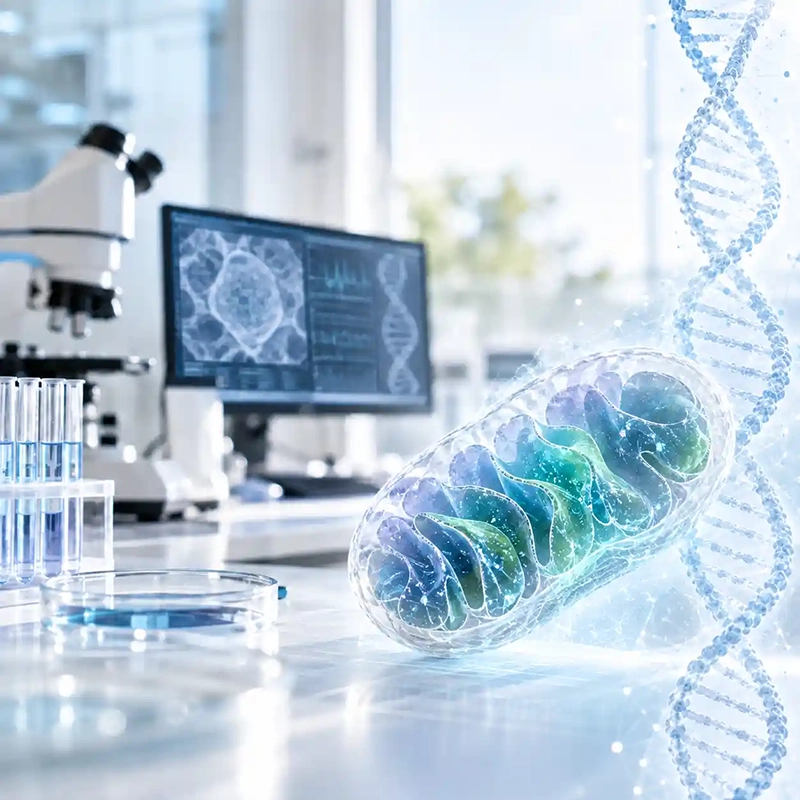
Mitochondria are often described as the “powerhouses of the cell”, but their role extends far beyond energy production. These tiny organelles contain their own DNA, inherited primarily through the maternal line. Changes in mtDNA can affect mitochondrial function and contribute to various mitochondrial disorders, complex conditions that can impact multiple organs and systems.
Mitochondrial diseases can result from genetic changes in either mitochondrial DNA or nuclear DNA (which contains genes essential for mitochondrial structure and function). Because mitochondria are involved in so many cellular processes, these disorders can present in remarkably diverse ways [1].
As genomic technologies continue to advance, understanding mitochondrial genetics has become an important part of research into inherited metabolic and multisystem disorders. DNA GTx supports the application of genomic technologies to explore genetic variation and its relationship with human health and disease.
What Can mtDNA Testing Reveal?
Mitochondrial genetic testing can help identify specific variants within the mitochondrial genome, supporting the investigation of suspected mitochondrial disease [2]. At DNA GTx, our genomic analysis may provide information about:
- mtDNA sequence variants: Specific changes in the mitochondrial genetic code
- Pathogenic variants: Genetic changes associated with disease
- Heteroplasmy levels: The proportion of normal versus altered mtDNA within cells
- Maternal inheritance patterns: How variants are passed through families
- Genetic changes affecting mitochondrial function
Understanding Heteroplasmy
One feature that makes mitochondrial genetics particularly complex is heteroplasmy, the presence of a mixture of normal and altered mtDNA within cells or tissues. The proportion of a particular variant can vary between tissues and between individuals, making interpretation challenging but also offering valuable insights into disease mechanisms.
Why Explore Mitochondrial Genetics?
Mitochondrial genetic testing may be relevant when a mitochondrial disorder is suspected based on clinical findings, family history, or other investigations [3]. DNA GTx can support:
- Investigation of suspected inherited mitochondrial disorders
- Identification and assessment of mtDNA variants
- Understanding of maternal inheritance patterns
- Genetic and molecular research
- Family and reproductive genetic evaluation where clinically appropriate
- Advancement of research into mitochondrial disease mechanisms

The Path to Precision Medicine
Mitochondrial disorders can present differently between individuals even when they involve related genetic mechanisms. This biological diversity highlights why understanding each person’s specific genetic and molecular characteristics matters.
Advances in sequencing and bioinformatics are enabling researchers and clinicians to investigate mitochondrial genomes with increasing resolution. By integrating mtDNA information with nuclear genomic, clinical, and other molecular data, we can build a more comprehensive view of mitochondrial disease biology [4].
This integration represents an important step toward precision medicine, where genetic and molecular information contributes to more individualized approaches to disease investigation and management. DNA GTx is committed to advancing this precision-medicine approach.
The Future of Mitochondrial Genomics
- Our understanding of mitochondrial disease continues to evolve as genomic technologies improve. Future developments may enable:
- More comprehensive mitochondrial genome analysis
- Improved detection and interpretation of mtDNA variants
- More accurate assessment of heteroplasmy
- Integrated analysis of mitochondrial and nuclear DNA
- Enhanced biomarker discovery through multi-omics approaches
At DNA GTx, the application of advanced genomic approaches supports the growing need for comprehensive molecular investigation of mitochondrial disorders, contributing to a more detailed understanding of genetic variation and its potential clinical relevance.
The growing use of multi-omics approaches may further support biomarker discovery and improve our understanding of genotype-phenotype relationships. Through genomic testing and precision-medicine approaches, DNA GTx aims to contribute to the evolving landscape of mitochondrial genomics and support a more comprehensive understanding of mitochondrial health and disease [5].
Explore Mitochondrial Genetics with DNA GTx
Understanding mtDNA variation, heteroplasmy, and the interaction between mitochondrial and nuclear genomes can provide valuable insights into the molecular complexity of mitochondrial disorders [6].
With DNA GTx, genomic technologies can support the exploration of genetic variation and contribute to the growing field of precision medicine.
Whether you’re a clinician investigating a suspected mitochondrial disorder, a researcher exploring mitochondrial biology, or a family seeking genetic evaluation, DNA GTx offers advanced genomic solutions to support your needs.
Our mitochondrial genetic testing identifies variants linked to suspected mitochondrial disorders and should be interpreted alongside clinical and family history.
DNA GTx — Advancing Genomics for Precision Health
📚Referências
- Suomalainen, Anu, and Brendan J. Battersby. “Mitochondrial diseases: the contribution of organelle stress responses to pathology.” Nature reviews Molecular cell biology 19, no. 2 (2018): 77-92.
- Mavraki, Eleni, Robyn Labrum, Kate Sergeant, Charlotte L. Alston, Cathy Woodward, Conrad Smith, Charlotte VY Knowles et al. “Genetic testing for mitochondrial disease: the United Kingdom best practice guidelines.” European Journal of Human Genetics 31, no. 2 (2023): 148-163.
- Parikh, Sumit, Amy Goldstein, Mary Kay Koenig, Fernando Scaglia, Gregory M. Enns, Russell Saneto, Irina Anselm et al. “Diagnosis and management of mitochondrial disease: a consensus statement from the Mitochondrial Medicine Society.” Genetics in Medicine 17, no. 9 (2015): 689-701.
- Macken, William L., Micol Falabella, Chiara Pizzamiglio, Cathy E. Woodward, Elizabeth Scotchman, Lyn S. Chitty, James M. Polke et al. “Enhanced mitochondrial genome analysis: bioinformatic and long-read sequencing advances and their diagnostic implications.” Expert Review of Molecular Diagnostics 23, no. 9 (2023): 797-814.
- Wu, You, and Lei Xie. “AI-driven multi-omics integration for multi-scale predictive modeling of genotype-environment-phenotype relationships.” (2025): 265-277.
- Chinnery, Patrick Francis, and Gavin Hudson. “Mitochondrial genetics.” British medical bulletin 106, no. 1 (2013): 135-159.
Recent Blogs



Tem alguma dúvida?
Tem uma pergunta ou solicitação específica? Preencha o formulário abaixo e nossa equipe entrará em contato com você em breve.