





Sequenciamento Completo do Exoma: Revelando Respostas para Doenças Raras e Hereditárias
Página inicial > Blogs > Sequenciamento Completo do Exoma: Revelando Respostas para Doenças Raras e Hereditárias
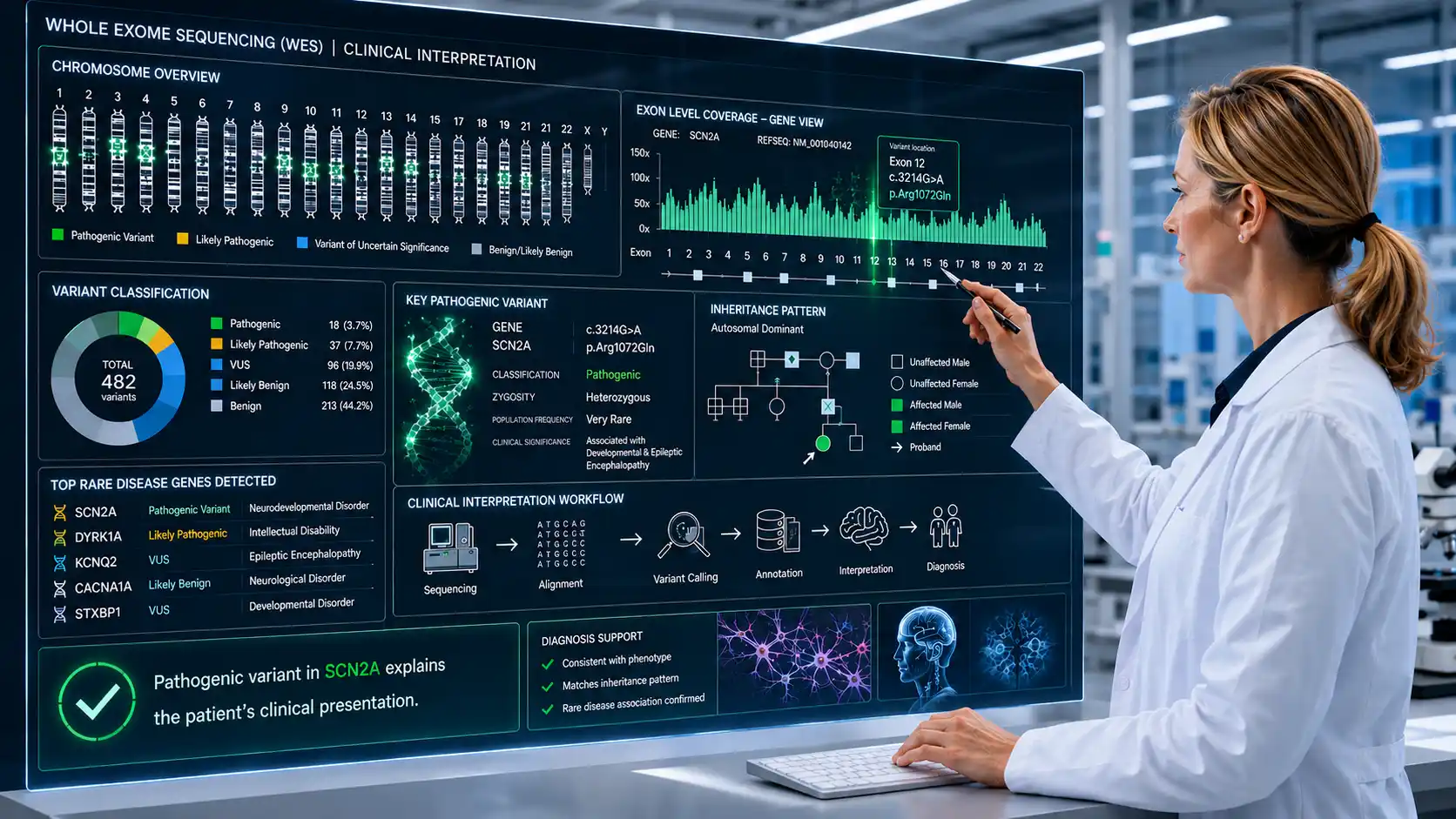
O que é o Sequenciamento Completo do Exoma?
O Sequenciamento Completo do Exoma (WES) é uma poderosa tecnologia genômica que analisa as regiões codificadoras de proteínas do genoma, conhecidas como éxons. Embora os éxons compreendam apenas 1–2% do genoma humano, eles abrigam aproximadamente 85% das variantes genéticas conhecidas causadoras de doenças, tornando o WES uma abordagem altamente eficiente e de excelente custo-benefício para identificar a base genética de uma doença.
Desde a sua introdução na genômica clínica, o WES transformou o diagnóstico de distúrbios genéticos raros e demonstrou sua utilidade clínica em estudos genômicos de grande escala [1]. Ele se tornou uma ferramenta essencial na medicina genômica moderna, apoiando o diagnóstico de uma ampla gama de distúrbios hereditários e complexos.
Na DNA GTx, o Sequenciamento Completo do Exoma é integrado a análises bioinformáticas avançadas e interpretação clínica especializada para entregar informações genômicas precisas, confiáveis e clinicamente significativas, que dão suporte ao diagnóstico de precisão e a melhoria do cuidado ao paciente.
Quem pode se beneficiar do Sequenciamento Completo do Exoma?
O Sequenciamento Completo do Exoma pode ser considerado para indivíduos com suspeita de condições genéticas quando a causa subjacente permanece incerta. É particularmente valioso para pacientes que:
- Apresentam sintomas que afetam múltiplos sistemas de órgãos
- Apresentam características clínicas complexas ou atípicas
- Têm suspeita de um distúrbio hereditário sem um diagnóstico confirmado
- Foram submetidos a testes genéticos anteriores com resultados inconclusivos
- Têm histórico familiar sugestivo de uma condição genética
- Buscam um diagnóstico molecular para orientar a conduta clínica e o aconselhamento genético
Ao fornecer uma análise abrangente de milhares de genes simultaneamente, o WES pode ajudar a descobrir causas genéticas que podem não ser identificadas por meio de abordagens de testes convencionais.
Por que o Sequenciamento Completo do Exoma É Importante

Para muitos pacientes com suspeita de distúrbios genéticos, alcançar um diagnóstico pode envolver anos de consultas médicas e múltiplos exames inconclusivos. Essa jornada prolongada, frequentemente chamada de “odisséia diagnóstica”, pode atrasar o tratamento adequado, o manejo da doença e o acesso ao aconselhamento genético.
O Sequenciamento Completo do Exoma transformou esse processo ao permitir a análise abrangente de milhares de genes clinicamente relevantes em um único teste. Um diagnóstico molecular confirmado pode ajudar a esclarecer a causa da doença, orientar a conduta clínica, dar suporte ao aconselhamento genético, embasar o planejamento familiar e fornecer informações valiosas para os pacientes e suas famílias.
Aplicações Clínicas do WES
O Sequenciamento Completo do Exoma tornou-se uma ferramenta diagnóstica importante em diversas especialidades médicas. É amplamente utilizado na investigação de distúrbios genéticos raros, condições pediátricas e do neurodesenvolvimento, epilepsia, deficiência intelectual, doenças neuromusculares, distúrbios neurológicos e neurodegenerativos, condições metabólicas hereditárias e síndromes de câncer hereditário. O WES é particularmente valioso para pacientes com condições complexas ou geneticamente heterogêneas nas quais a causa subjacente permanece desconhecida [2,3].
Quando clinicamente apropriado, o sequenciamento do paciente juntamente com ambos os pais biológicos (WES Trio) pode melhorar ainda mais a precisão diagnóstica, ajudando a identificar variantes de novo e a esclarecer padrões de herança. Para muitos pacientes, essa abordagem abrangente pode reduzir o tempo e os custos associados a exames repetidos, ao mesmo tempo em que aumenta a probabilidade de se alcançar um diagnóstico definitivo [3]

DNA GTx: Avançando na Genômica de Precisão
Na DNA GTx, estamos comprometidos em oferecer testes genômicos de alta qualidade apoiados por robustos pipelines de bioinformática, interpretação especializada de variantes e rigorosos padrões de qualidade. Nossa equipe multidisciplinar trabalha em estreita colaboração com profissionais de saúde para fornecer informações genômicas clinicamente acionáveis que auxiliam o diagnóstico preciso e a melhoria do cuidado ao paciente.
Também reconhecemos a importância dos testes genômicos responsáveis e mantemos os mais altos padrões de confidencialidade do paciente, segurança de dados e práticas éticas de laudos.
A interpretação de variantes segue diretrizes e padrões internacionalmente reconhecidos, incluindo as recomendações do ACMG [4].
Conclusão
O Sequenciamento Completo do Exoma tornou-se uma pedra angular do diagnóstico genômico moderno, permitindo a identificação de variantes genéticas causadoras de doenças em um amplo espectro de condições hereditárias.
À medida que a medicina genômica continua a evoluir, o WES desempenha um papel cada vez mais importante no suporte a diagnósticos mais precoces, na tomada de decisões clínicas fundamentadas e na melhoria dos resultados para os pacientes. Por meio de tecnologias genômicas avançadas e interpretação especializada, a DNA GTx dedica-se a fornecer insights genômicos confiáveis que ajudam a impulsionar os cuidados de saúde de precisão.
📚Referências
- Ng SB, Turner EH, Robertson PD, et al. Nature. 2009;461:272–276. doi:10.1038/nature08250
- Yang Y, Muzny DM, Reid JG, et al. N Engl J Med. 2013;369:1502–1511. doi:10.1056/NEJMoa1306555
- Monroe GR, Frederix GWJ, Savelberg SM, et al. Genet Med. 2016;18:913–923. doi:10.1038/gim.2015.190
- Richards S, Aziz N, Bale S, et al. Genet Med. 2015;17:405–424. doi:10.1038/gim.2015.30
Recent Blogs

Tem alguma dúvida?
Tem uma pergunta ou solicitação específica? Preencha o formulário abaixo e nossa equipe entrará em contato com você em breve.